0:00
The future belongs to those who understand that AI needs direction, tools need
0:04
masters,
0:05
data needs insight, content needs context, success needs vision.
0:10
The mind is a story engine and those who learn to control it will thrive.
0:14
Most skills will be irrelevant in 10 to 20 years.
0:16
That is unless you completely change how you think about success.
0:20
Because if you're a high agency individual that doesn't matter, why?
0:24
Because you aren't dependent on a specific skill for your success.
0:28
Because you aren't a specialist, you didn't focus your mind, preventing you
0:32
from learning
0:33
outside of that focus on the status of a high paying job or degree.
0:37
You have a vision and you understand that in today's world you can learn any
0:41
skill or
0:41
acquire any knowledge that is needed to achieve it.
0:44
Now unfortunately, if your parents did not cultivate the skill of agency in
0:48
themselves,
0:49
they probably didn't pass it off to you.
0:51
And unless you have deliberately and painfully gone through the process of rele
0:55
arning, you
0:56
have some work to do before you feel in control of your future.
0:59
Now with that set, the most important skill to learn that will be relevant now
1:03
in 10 years
1:04
and until you die is agency.
1:06
Because if you can set your own life direction, do what is required to achieve
1:10
it and avoid
1:10
the infinite number of temptations and distractions in today's world, you will
1:14
never be at risk
1:15
of replacement.
1:16
And if you do get replaced, it doesn't matter because you can quickly adapt.
1:20
So in this video, I want to share five ideas on what agency is, why it matters
1:25
more than
1:25
ever and how to practice it so you can get what you want in life.
1:29
So the first idea is that agency is the ability to iterate without permission.
1:34
And this is a slight redefinition of what most people are talking about online
1:38
right
1:38
now in terms of agency, because they're saying that it is the ability to act
1:43
without permission.
1:44
But we'll see why that is wrong.
1:45
And maybe it isn't wrong.
1:47
Maybe that's the definition of agency, but I want to redefine it in a way that
1:51
is actually
1:51
useful to you.
1:52
So we'll start with a quote from Krishnamurti.
1:54
It is only those who are in constant revolt that discover what is true, not the
1:58
man who
1:59
conforms, who follows some tradition.
2:01
So in order to understand what a high agency individual is, it's very helpful
2:06
to understand
2:07
what it is not.
2:09
Agency is not mechanical conformity.
2:11
Conformity is when your mind is still connected by an umbilical core to society
2:16
.
2:16
Conformity is a stage of development where your mind operates entirely through
2:19
cultural
2:20
programming, judging truth based on popularity and acceptance by others, rather
2:24
than your
2:24
own direct experience or independent investigation.
2:27
Now if you really think about what I just said, if you don't understand what I
2:31
just
2:31
said, please go back and re listen to it.
2:33
You understand that that is one of the greatest threats to living a good life.
2:37
Now when you're born, your mind is like a new computer.
2:40
There's a base operating system, but the hard drive is completely blank.
2:44
For the first 20 years of your life, you do not think independently, and that's
2:49
okay,
2:50
nobody does, no matter how independent you think you are, because that's just
2:54
another
2:54
form of conformity.
2:55
The little kid that thinks he's rebelling against his parents is just con
2:58
forming to
2:59
what his friends want him to do.
3:00
Now in the spiral dynamics in nine stages of ego development models, they show
3:04
that
3:04
around 50% of the population is at the conformist stage of development, meaning
3:09
half the population
3:10
lacks the cognitive development for genuine agency.
3:13
Now conformity stems from survival, because humans don't only survive on the
3:17
physical
3:17
level, like animals, where they're reproducing genes, but they survive on the
3:21
psychological
3:22
level, where they're reproducing beliefs, ideas and information.
3:26
If you work a job, you have a low degree of agency in that domain of life,
3:29
because if
3:30
that job were to go away, your survival is at stake.
3:33
So you must conform in order to keep the job.
3:36
I mean, that's what you have to do to get the job in the first place is you
3:38
have to conform
3:39
to what you think the boss will like so that he can hire you.
3:43
And then while you're on the job, you have to maybe wear a specific dress code.
3:47
You have to go through a specific set of processes to do your work that are
3:50
approved by the
3:51
boss or your manager.
3:53
Maybe you have to conform to a nine to five style work day.
3:56
As another example, if you have hard set beliefs that bind you to a specific
4:00
political
4:00
party or religious organization, you do not have a high degree of agency,
4:04
because your
4:05
ideas of good and bad originate from your culture, not your own personal
4:09
investigation
4:10
or discovery, everyone in the tech and business space and the AI space right
4:14
now loves to
4:15
talk about being high agency, but that's just another form of conformity to
4:19
what is
4:19
popular in the tech and business space.
4:21
And if you're not talking about it, then you're not with it.
4:24
With that said, this video has some degree of conformity.
4:28
We're all conformists in some ways.
4:29
And since it's a survival strategy or survival tool, it can be used like a tool
4:34
.
4:35
I'm surviving in the sense that I'm trying to stay relevant in the YouTube
4:38
space.
4:38
So what does true agency look like?
4:41
And how can we start to develop it in ourselves so that our emotions, finances
4:46
and opportunities
4:46
in life aren't dictated by someone else?
4:49
The first thing it looks like is that high agency people iterate without
4:52
permission.
4:53
To have agency is to be the subject of a sentence rather than its direct object
4:57
.
4:58
It is the tendency to act rather than wait to be acted upon.
5:01
That is a quote from Devin Erickson's article, the third ingredient of success.
5:06
Now agency literally means the condition of being in action or operation.
5:11
When it's used to describe a person, it means the tendency to initiate action
5:15
towards a goal
5:16
without outside prompting instruction or permission.
5:19
But when we look at what actually makes people successful, it isn't just acting
5:23
toward a goal.
5:24
Anyone can start a business, but that doesn't mean it will reach any form of
5:27
success.
5:28
Most of them don't, in fact, because they're missing the one critical piece of
5:32
the puzzle.
5:33
If something doesn't work, you reflect on the situation, make an adjustment and
5:37
try again
5:38
over and over until you reach your end destination.
5:40
Agency then, in my opinion, is not only action, but an undying commitment to
5:45
iteration,
5:46
learning and doing in unison, making mistakes and correcting mistakes without
5:50
being seduced
5:51
back into a comforting conformity because it's not working quote, unquote.
5:55
And yes, I'm talking to you people who start and quit after two weeks.
5:59
Now, the second tell of a high agency person is that they treat life as one
6:03
giant experiment.
6:04
Low agency people can be characterized by the employee mindset.
6:08
They are assigned a task, often with some form of status or credential that
6:12
triggers the part of their brain
6:13
that craves acceptance by the tribe and their decision making is immediately
6:17
compromised.
6:18
They can no longer think outside of the confines placed upon them.
6:21
Now, high agency people are scientists of their own lives.
6:25
They have an idea.
6:26
They set their own goal.
6:27
They create a hypothesis or an educated guess on how to achieve it.
6:31
Then they test, tinker, research and make an attempt toward the goal.
6:35
And then they fail a lot.
6:36
But since this is an experiment, that's a part of the process.
6:39
They expect to fail because how else are they going to narrow down what doesn't
6:43
work
6:44
until they find what does?
6:45
Now, this is a significant issue with how people perceive success today.
6:49
They are promised something by someone else, like a job that pays a lot of
6:53
money or a business
6:54
that can be built really quickly so you can get rich quick.
6:58
And those people do exactly what they're supposed to do.
7:00
But when they inevitably fail, they deem it impossible and blame everyone but
7:05
themselves.
7:06
They don't notice that they made a mistake and that they can correct that
7:09
mistake and
7:09
try again.
7:10
Now, the third thing is that high agency people believe in the difficult.
7:14
You're watching this and you want to become high agency because you believe
7:18
that it will
7:19
make a positive difference in your life.
7:21
You're trying to reach a goal, you're trying to achieve a goal and goals come
7:25
in three
7:25
forms.
7:26
There's easy goals.
7:27
So things that we do every day or things we can achieve with the skills or
7:31
resources
7:31
we already have.
7:32
There's difficult goals.
7:34
So things we can't do right now, but that we can eventually do if we acquire
7:37
the right
7:38
skills and resources.
7:39
And then there's impossible goals.
7:41
So something that is either outside of the realm of possibility and reality or
7:44
something
7:45
we can't do until we complete the series of difficult goals that allow us to
7:48
see impossible
7:49
goals as possible.
7:51
So low agency people have a belief system that was more than likely conditioned
7:55
into
7:56
their mind when they were a kid or later on in life with any kind of ideology
8:00
they accepted
8:01
into their life like a political party, a religion, a friend group they joined.
8:05
And that belief system skews how they perceive difficult goals.
8:10
They see difficult goals as impossible goals and don't even try them.
8:14
And they don't even understand that impossible goals are only impossible right
8:18
now until
8:19
you get to a point where they become possible.
8:21
Now if you take Seligman's dog experiment, which is an experiment done on dogs,
8:25
you can
8:26
see how society does just this to most people.
8:29
So in this experiment, dogs were exposed to unavoidable electric shocks, making
8:33
them feel
8:34
as if they had no control over their environment.
8:36
Later, when they were placed in a situation where they could simply jump over a
8:39
small
8:40
wall to escape the shocks, the dogs did not attempt to do so.
8:44
They just wind and bore the shocks even when escaping was easily available to
8:47
them.
8:48
So the goal of reaching the life you want may be difficult, but you were
8:52
trained to believe
8:53
that there is no way to achieve it.
8:55
So you don't even think about it or consider that idea.
8:58
In other words, you're just trained to bear the shocks of the default path.
9:02
You just think that the pain of the life that everyone is going through is
9:07
normal and
9:08
not optional.
9:09
The good thing is, is that there is a way to practice agency.
9:13
You can cultivate it as a skill or a trait.
9:16
But these practical steps don't matter unless you have a deep understanding of
9:20
how this
9:20
applies in today's world.
9:22
So those were the characteristics of what a high agency person is, and now we
9:27
need to
9:27
move on to the second idea, which is that AI is not a threat to the high agency
9:32
people.
9:33
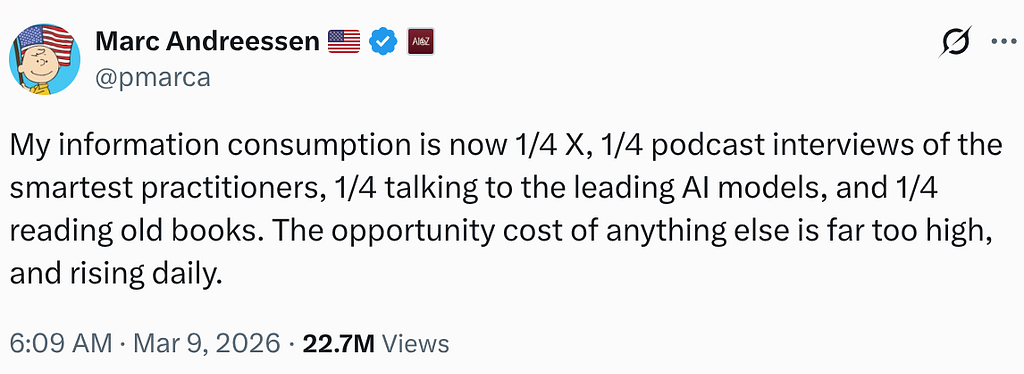
To illustrate this, here's a tweet that I wrote a while back and it got a lot
9:36
of engagement
9:37
for some reason, but it's just how I've been using AI.
9:40
Use a task, find a YouTube expert that teaches it, have AI summarize their
9:44
video at example
9:45
slash context, have AI turn that into a meta prompt test refine and reuse that
9:50
prompt.
9:50
This has led to the best results and almost everything I have a, I do actually
9:54
broke down
9:54
that entire process to videos ago.
9:57
I don't remember what the video is called, but the thumbnail says learn AI in
10:01
34 minutes
10:02
or 29 minutes says something like that.
10:04
Okay.
10:05
So back to the point, you now have access to any knowledge you would ever need
10:09
to achieve
10:09
whatever you want.
10:10
And yet people still do nothing with that information.
10:14
That's a crucial point.
10:15
Success is now easier than ever, yet the people who weren't going to achieve it
10:19
still aren't
10:20
going to achieve it, meaning this was never about access or equal opportunity.
10:24
It's always been about agency high agency people.
10:28
On the other hand, we'll outpace everyone else by 10x because they act without
10:32
permission
10:32
and the barriers to action are now close to non-existent.
10:36
If you can't achieve a big goal due to limited money or resources, you can set
10:40
a smaller
10:40
stepping stone goal that will help you acquire that money or resource.
10:44
Everyone is worried about the same thing.
10:46
And frankly, they're only afraid because they can't think clearly.
10:49
So let's look at the prime example, which is that AI is going to create so much
10:53
content
10:54
that human creators don't stand a chance.
10:55
I'm actually writing about this right now.
10:58
You can read it on my newsletter link in the description.
11:01
First thing here is that AI is a tool.
11:03
Those need someone to use them for a specific purpose.
11:07
So sure, anyone can ask AI to generate a viral post or a thousand viral posts
11:12
from a podcast
11:14
and the AI can rank them or run a simulation on whether or not they're actually
11:18
going to
11:18
go viral.
11:19
But what good is that?
11:20
What actual good is that?
11:22
Have you thought about it or have you just heard that and been like, Oh yeah,
11:24
that sounds
11:25
kind of true.
11:26
Okay.
11:27
I'm done thinking about it.
11:28
You can get a bunch of likes and a bunch of followers that way.
11:30
But what about monetization?
11:32
What about loyalty or what about any of the other things that make a brand work
11:36
long term?
11:37
Yes, you can ask AI to help with that or help you understand it.
11:41
But now you're doing something completely different.
11:43
You're not asking AI to do it for you.
11:46
You're learning now.
11:47
You're orchestrating the realization of a larger vision and it's not that
11:51
different from
11:52
doing it yourself.
11:53
You're just getting the information from a different source now in a faster way
11:57
.
11:57
You are still the decision maker.
11:59
And sure AI can generate a beautiful image on command, but there is a huge
12:03
difference
12:04
between someone who has a vision and uses AI to help them execute that vision
12:09
and someone
12:10
who just wants to create a quick image.
12:12
Many artists nowadays use AI for first drafts.
12:15
Many artists still take it into Photoshop and make tweaks that would allow it
12:19
to look more
12:19
like what they want it to look like because you can't get super detailed with
12:23
the image
12:23
generators right now.
12:25
So as a whole, I believe that AI has exposed what really matters in the
12:30
creative process.
12:31
When you ask AI to make all the decisions for you, in other words, you ask it
12:35
to guess
12:36
what works based on hundreds of thousands of opinions on the internet.
12:39
There is no through line.
12:41
There is no theme.
12:42
There is no personality.
12:43
There is no vision.
12:44
There is no context.
12:45
That's what creators are.
12:47
Context creators.
12:48
They're not content creators.
12:50
The content is meaningless without context and AI generations are the same.
12:55
So aside from brain rot and memes, and there's actually some great ones out
12:58
there actually
12:59
like scrolling and seeing some of the brain rot, which are only good at keeping
13:02
you on
13:03
the platform until you see an advertisement so the social media platforms can
13:06
make money,
13:07
which then have a through line and brand vision crafted for a specific purpose
13:11
by a specific
13:11
person using AR or not, AI is practically useless unless the person using AI is
13:17
already
13:18
good at creating content.
13:20
Did that click for you?
13:21
99% of AI generated content goes straight to the bottom of the barrel because
13:26
if that
13:26
content worked, then there's value there and it doesn't matter if it was AI
13:30
generated
13:31
or not because it was more than likely orchestrated by a human who was passing
13:35
off their personal
13:36
context to it.
13:37
When building a business, you must have a brand mission that AI helps you
13:40
execute and
13:41
you must iterate constantly.
13:43
When writing a book, you must maintain control of all minor details and beyond
13:47
that, you
13:47
must still be able to get people to read it.
13:49
Things marketing and sales, which the book is not going to do itself.
13:53
When creating art, you must still have an idea that you are attempting to bring
13:56
into reality.
13:58
In other words, nothing has changed.
14:00
People just hate what's new and that new is shining a light on what mattered in
14:03
the
14:03
first place.
14:04
If you can't create art with AI, then you are never an artist to begin with.
14:08
You were simply good at using a tool like Photoshop and tools get replaced.
14:13
Vision and agency do not.
14:15
So, speaking of that, that brings us to idea number three, is why generalists
14:20
win in the
14:21
AI age.
14:22
Schools were created to enslave the brightest minds by promising the prestige
14:25
of specialization
14:26
so they remained narrow-minded and didn't overthrow the true rulers.
14:30
That is a quote from my book that you can read free on my sub-stack purpose and
14:33
profit
14:34
that is taken quite a bit out of context, but that quote is largely true.
14:38
Now, whenever I write or create a video on becoming a generalist or a polymath
14:42
or someone
14:42
with multiple interests, people just seem to pop up and they want to tell me
14:46
how wrong
14:47
I am.
14:48
And of course, they never give me a coherent argument as to why a specialist is
14:51
better.
14:51
Actually, sometimes they do, but they don't actually listen to what I'm saying
14:55
in the
14:56
first place.
14:57
They don't steal me on my argument.
14:58
They usually inadvertently prove me right.
15:00
And some of them even proceed to quote the classic from Shakespeare, which is a
15:05
jack of
15:05
all trades, master of none, yet they're unaware that that is a misquote and it
15:10
ends with,
15:11
oftentimes better than a master of one.
15:13
Now, some may think Shakespeare was a specialist playwright, but that was
15:16
simply a vessel.
15:17
He had to have a deep understanding of human nature, character development,
15:21
language, classical
15:22
literature, stagecraft, religion, philosophy, military tactics, music,
15:25
navigation, the natural
15:27
world, social structures, the body and medicine, the list goes on.
15:30
He was a synthesizer who used his diverse interests as his edge.
15:34
Now take a fortune 500 CEO, Charles Darwin, Steve Jobs, or any other visionary
15:39
or strategist
15:40
who achieves outside success has a specific vision that they then learn and
15:44
take the necessary
15:45
steps to achieve.
15:46
Do not confuse a specific vessel or niche as being a specialist specialists are
15:52
attached
15:52
to the skill skills always get replaced and evolved as technology advances.
15:57
We don't see this now, but Photoshop disrupted the art industry.
16:01
You see Photoshop now and you see it as an integral part of our process, but I
16:05
can guarantee
16:06
if we were back in those times where Photoshop came around or not even just
16:10
Photoshop, but
16:11
computer generated graphics came around.
16:13
The manual hand drawn artists were probably just screaming at the top of their
16:17
lungs
16:17
that this is going to ruin everything.
16:19
That's exactly what's happening right now with AI.
16:22
And while I'm very pro AI, there's going to be more videos on me talking about
16:26
the
16:26
other side.
16:27
I think there's things that are very, very wrong with AI like the content
16:30
creation space
16:31
right now and people just asking, Hey, create me a script for this.
16:34
And then they just read it to the camera and you can obviously tell that they
16:37
're using
16:38
AI.
16:39
I have a lot to say about that.
16:40
Now, generalists, on the other hand, they aren't, they don't care whether or
16:43
not the
16:44
skill is going to be replaced or if it's going to evolve because they're
16:47
focused on
16:47
the goal.
16:48
They're focused on the vision.
16:49
They're focused on doing what's necessary, including changing the goal so that
16:54
they can
16:54
thrive in anything they do.
16:56
They don't identify with a skill or think they're passionate about a skill like
16:59
being
17:00
passionate about Photoshop.
17:01
They're passionate about their direction in life and creating that.
17:05
So let me break this down further.
17:07
Humans are tool builders.
17:08
We thrive in any niche because we can adapt to it.
17:11
If you were to put a lion in Alaska and a polar bear in the Savannah, they
17:15
would die.
17:16
If you were to put a human in either, they would build shelter, clothing and
17:20
hunt for
17:20
something to eat because they can create a plan and execute on it.
17:23
The reality is to educate large numbers of immigrant children in the 1800s
17:28
during industrialization,
17:29
America adopted the Prussian education model, which was not education at all,
17:33
but a weapon
17:34
of mass conformity.
17:35
It was designed to create obedient soldiers, compliant citizens, civil servants
17:39
and will
17:40
behave workers through mandatory attendance, training for teachers, testing for
17:43
students
17:44
in the concept of grade levels.
17:46
Does that sound familiar?
17:47
Society wants you simple, predictable and easy to categorize.
17:51
Why?
17:52
Because that's what best serves their interests.
17:54
That's what best serves the profits of organizations.
17:56
If you understand systems, you understand that the system takes the shape of
18:00
that which most
18:01
benefits the end goal, which in society's case is keeping you sick and dumb,
18:05
whether
18:06
it's intentional or not.
18:07
It doesn't have to be a conspiracy theory for the system to naturally take
18:11
shape of
18:11
the subconscious desires of the humans at the top of the pyramid.
18:15
So what do you do?
18:16
What do you do about all this?
18:17
Well, if slaves were expected to do one thing throughout the entirety of their
18:21
lives so
18:21
that their minds were closed to learning more, which are specialists, then you,
18:25
as a free
18:26
individual, are meant to do many things throughout your life, you're meant to
18:29
be a generalist.
18:30
In other words, you revolt against the path you were set on at birth.
18:34
You pursue an interest-based education, you use your capabilities wisely, and
18:39
that's
18:39
idea number four, which is the five human capabilities.
18:43
Now agency is great, but we're still bound by the laws of physics, and this
18:46
creates another
18:47
giant worry that ebbs and flows with AI hype cycles.
18:51
Will AGI, artificial general intelligence, make human intelligence irrelevant?
18:56
Let's gain clarity on this by asking a few questions.
18:58
We're going to go through this quick.
18:59
Are human capabilities limited, or are they infinite?
19:02
As high agency generalists, do we not have the capability to learn anything and
19:06
do anything
19:07
that our genes do not limit us from learning or doing?
19:10
We thrive in many niches because we adapt with knowledge and tools.
19:13
So the fundamental question about human capabilities is, are there any limits
19:18
on what we can think
19:19
and how we can think?
19:21
So if the main limit is the processing speed and memory of our brain, can that
19:25
not be augmented?
19:26
And when AGI becomes a thing, will that not be ever more possible?
19:30
Will we not be AGI?
19:31
Are we not already AGI?
19:33
Will we not be amongst the super-intelligent?
19:35
It's fun to speculate about these things and we have some time before it
19:38
actually becomes
19:39
reality, so I want to focus on the near future.
19:42
So there are five fundamental human capabilities.
19:45
Can AI or AGI ever make those irrelevant?
19:49
The first capability is computation, which is mental.
19:52
So is there any limit to what we can compute?
19:54
No, because once you have a universal computer that we can hold in our hands,
19:58
it's just a
19:59
matter of time and memory to compute anything.
20:01
We have that, and if AGI's or aliens have that, they would have the same
20:05
repertoire
20:06
of computation as us and no advantage over us.
20:09
You may say that AGI will be able to compute much faster, but that does not
20:12
speed up the
20:13
pace of the physical transformation that allows things to be built.
20:18
You can have an idea for building a particle collider, but you still need the
20:21
resources
20:22
to build it, and you still need to build it from that.
20:25
The second capability is transformation, which is physical.
20:29
Transformation is creation.
20:30
We turn raw materials into rockets given the right knowledge.
20:34
Human hands and bodies seem to be especially good at creating anything given a
20:38
specific
20:38
sequence of operations.
20:40
We've built spaceships and telescopes, meaning that we can build the thing that
20:43
builds the
20:44
thing.
20:45
We have analysts that build tools to thrive in any environment.
20:47
We are not animals bound to one niche.
20:50
So the question is, is there a limit to what these basic operations can do when
20:54
strung together
20:55
in the right way?
20:56
Now again, the answer is no.
20:58
If humans could tele-operate a gorilla, there is a sequence of steps it can
21:02
take to build
21:02
a rocket given time.
21:04
And no, I'm not saying a single gorilla.
21:07
Imagine if Elon Musk were operating the gorilla.
21:09
What would he do?
21:10
The thing here is time, transformations take time, and a singularity isn't
21:15
going to change
21:16
that just as the enlightenment or the big bang didn't.
21:19
The big bang didn't create rocket ships.
21:21
The enlightenment didn't create rocket ships.
21:23
It created maybe some prerequisites for them, but it still took time to get to
21:27
that point.
21:28
Time is a compression algorithm that prevents everything from happening at once
21:32
.
21:32
In other words, AGI may be able to compute faster than our brains, but that
21:36
doesn't
21:36
mean it will be able to create the thing faster than humans.
21:39
You can have an idea for building a rocket, but you still need to acquire the
21:43
resources
21:43
to build a rocket.
21:44
Now, after computation and transformation as the two capabilities, there is
21:48
variation,
21:49
selection, and attention, and these have to do with navigating idea space, or
21:54
how we
21:54
create knowledge.
21:56
We can compute and transform, but do we have limits on the knowledge that
21:59
allows us to
22:00
do so?
22:01
Now, knowledge serves two functions.
22:03
The first is to make specific things happen, preferably good things rather than
22:07
bad, and
22:08
the second is to capture patterns in reality.
22:10
This allows us to store information in an efficient way so that we aren't
22:13
always starting
22:14
from scratch in our pursuits.
22:16
We understand big-picture concepts like the sun rising and falling each day,
22:20
and seasons
22:21
changing every so often.
22:22
Now without this understanding, much of our lives would fall apart.
22:26
Capturing patterns allows us to plan by proximity.
22:28
We understand that we could freeze to death in a cold environment, so we use
22:32
deposits of
22:32
knowledge, like a jacket, and hotel, to keep us warm while we travel.
22:37
Now think of idea space, or the unknown, as a universal map with light and dark
22:42
spots.
22:42
The light spots are the areas you've explored, and the dark spots are where
22:46
your potential
22:47
lies.
22:48
This map is a surface area for ideas that can be discovered and tested against
22:52
reality
22:52
to verify their validity.
22:54
When those results do not move you closer toward your goal, or move you further
22:58
from
22:58
that, a problem is revealed and you must error-correct toward the goal.
23:02
So with variation, the third capability is there a limit to the number of new
23:07
ideas we
23:07
can come up with to survive and achieve what we set our minds to.
23:11
With computation, we can navigate the entire space of ideas, with agency we can
23:15
take any
23:15
step within that space and eventually stumble across a good idea after many bad
23:20
ones, and
23:21
with creation we can move in unique ways, like flying over a forest rather than
23:25
walking
23:25
through it.
23:26
So we can understand anything, create anything, and discover an infinite set of
23:30
new ideas
23:31
to solve an infinite string of problems.
23:33
Again, AGI can do the same, and we are both bound by the laws of nature, but
23:37
any possibility
23:38
within that is within reach.
23:40
Now the fourth capability is selection.
23:43
We can come up with any idea, but can we find the good ones?
23:46
Now the potential problem here is that it is difficult to make cumulative
23:49
progress without
23:50
learning from mistakes.
23:51
It wouldn't be fun to start over from scratch if we wanted to build an electric
23:56
car after
23:56
a gas car.
23:57
We wouldn't be very developed as a species.
23:59
As universal, cybernetic systems, that's what humans are, we can become more
24:03
efficient
24:04
at navigating idea space to avoid wandering lost.
24:07
We error correct.
24:09
We make mistakes and fix them.
24:10
There's no fundamental difference here either.
24:12
Now the fifth capability is attention.
24:15
One other aspect that humans take for granted is our ability to change our
24:18
focus by changing
24:19
our perspective.
24:20
When a problem occurs, where does your attention go?
24:23
If you want to build a rocket, does it help to ask the old gods to do it for
24:27
you?
24:28
Or can you change lenses to view the situation in a way that allows you to
24:32
perceive opportunities?
24:33
While this is a massive problem for humans, because we get stuck in paradigm
24:36
walk and
24:37
we attach to ideologies, we do have the capability to change where our
24:41
attention goes when problems
24:42
come up.
24:43
We can put on a spiritual lens to find peace and a scientific lens to find
24:48
progress.
24:49
Identifying with a purely ascending and spiritual philosophy is no different
24:52
from being an incomplete
24:53
system that will fail to solve a certain set of problems.
24:57
Security is a great lens or tool, but a bad master and not the end all be all.
25:02
So, AGI does not seem like it can surpass us in any way unless it bends what is
25:06
possible
25:06
and we would have a very different problem on our hands at that point.
25:10
Now the fifth idea about agency is just how to actually practice agency.
25:14
In ordinary practical life, we usually take the means for the sake of the ends.
25:18
But in games, we can take up an end for the sake of the means.
25:22
Playing games can be a motivational inversion of ordinary life.
25:26
But as a quote from the book games, agency is art.
25:29
You develop agency by practicing other people's agencies until you can create
25:34
your own.
25:35
In other words, you play by the rules until you can create your own, meaning
25:39
the most
25:39
important high agency trait is knowing when to break free of conformity.
25:44
Agency as a whole is not a skill or a trait, but an art form.
25:48
And the best way to observe that art form is in games because painting lets us
25:53
record
25:53
sights, music lets us record sounds, stories let us record narratives, and
25:59
games let us
25:59
record agencies.
26:01
When you play a game, you almost always start with the goal in mind.
26:04
Win the game.
26:05
From there, you have various quests, but those quests must be executed in order
26:09
of your
26:09
experience.
26:10
You start at level one, then advance to level two and beyond.
26:14
And once you reach a much higher level, you are able to look back with all of
26:17
your knowledge
26:18
and skill to devise how you are going to reach the next goal.
26:21
The higher level you are, the more fun life becomes because you get to choose
26:24
the challenging
26:25
yet meaningful goal you take on next.
26:28
It is not a sign to you as if you were in a tutorial phase.
26:31
That's exactly why your life may feel out of control.
26:34
You got to level ten, childhood, school, or job, but now you feel stuck.
26:38
The game isn't fun anymore because the game makers don't benefit from you going
26:42
to a
26:42
higher level, so they incentivize you to stay there.
26:45
You get trapped in a loop of boredom and anxiety because all of your tasks are
26:49
repetitive
26:49
and mindless, and any further challenge overwhelms you because you do not know
26:53
how to learn.
26:54
The most important boss fight of your life is to pursue your own path.
26:58
So how do you actually start practicing this?
27:01
First, you simply need something to pursue, and it can be anything because
27:05
nobody actually
27:05
knows what they want.
27:07
Instead, they deeply understand what they don't want and allow that to create
27:11
an aim
27:12
for their future.
27:13
From there, they have a direction to move in.
27:15
Once you have that direction, you set a goal to make it more practical and
27:19
achievable,
27:20
and then you do the following.
27:21
You research processes that others have found success with.
27:25
You can find these on YouTube, social media, courses from reputable creators or
27:28
mentors.
27:29
Then you experiment with various techniques to implement the processes you
27:33
learn and attempt
27:34
to get results.
27:35
By the way, most of these won't work for you, and that's okay.
27:38
Then you identify patterns, principles, and levers, so note the most important
27:42
aspects
27:42
from everything you try.
27:44
These tend to be the things that get results.
27:46
Then you create your own process, so tailor what you learn to your unique
27:49
lifestyle and
27:50
situation, and then you pass it down to others, because the teacher learns more
27:54
than the student,
27:55
and you don't truly understand it if you can't explain it in a way that is
27:58
beneficial
27:59
to someone else.
28:00
This is personally why I love social media.
28:02
First, it's where the attention is, and you're probably not going to build your
28:06
life's
28:06
work by advertising on the radio, or getting on the TV anymore, or by sending
28:11
handwritten
28:12
letters to prospects, you're going to write content, obviously.
28:16
So aside from being an accessible, low cost, and low risk vessel to do what you
28:21
want, learning
28:21
and agency are baked in.
28:24
Social media, the internet, is the great modern game.
28:27
You can study other people's agencies and their content, guides, and courses.
28:31
You can experiment in public and get direct feedback.
28:34
You can quickly identify what works and what doesn't.
28:36
You are forced to learn a future-proof skill stack, like writing, persuasion,
28:40
marketing
28:40
sales, storytelling, et cetera, and you must truly learn what you want to talk
28:44
about on
28:45
the internet.
28:46
I'll let you decide what you want to do with the rest of that information.
28:49
If you like this video, I'd highly recommend subscribing to my sub stack.
28:52
I send out a newsletter every week or so, and I also send out a paid newsletter
28:56
twice
28:57
a month, so if you want to support this channel, support the things that I'm
29:00
building, consider
29:01
joining the paid tier.
29:02
In there, I have some prompts that I use in my own process, AI prompts.
29:06
I have writing tips, social media tips.
29:09
There's a full one-person business launchpad course in there, so go check it
29:12
out, sign
29:12
up if you'd like.
29:13
Like and subscribe before you leave.
29:15
There are just buttons on your phone.
29:16
Thank you for pressing them.
29:18
I'll see you in the next video.
29:19
Bye.








回复